How to improve your posture - by MD Thordis Berger
We often hear that good posture is beneficial to our health in many ways. But what does “posture” actually mean? The posture is the position you take while standing, sitting, or lying down. You have good posture when your position puts the least strain on supporting muscles and ligaments while you move or perform a stressful activity.
For this reason, proper posture reduces abnormal wear and tear on joint surfaces, which can lead to arthritis. It also reduces stress on ligaments that connect spinal joints. Good posture helps you avoid developing an abnormal permanent position, which can cause spinal disk problems and constricted blood vessels and nerves.
Normally, we do not consciously maintain normal posture. Instead, certain muscles do it for us, and we don't even have to think about it. Several muscle groups, including the hamstrings and large back muscles, are critically important in maintaining a good posture.
Correcting your posture may feel awkward at first because your body has become so used to sitting standing or lying in a particular way. But with a bit of practice, good posture will become normal for you. Some classes such as Pilates or Yoga help you improve and train your body to get used to a better posture.
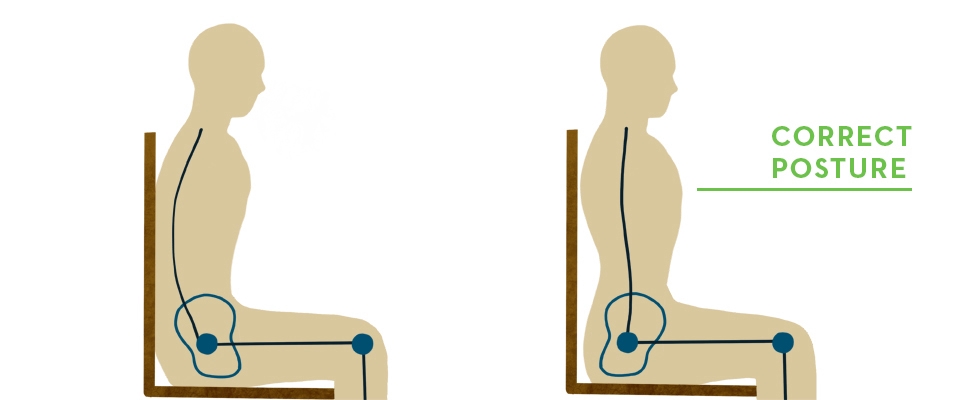
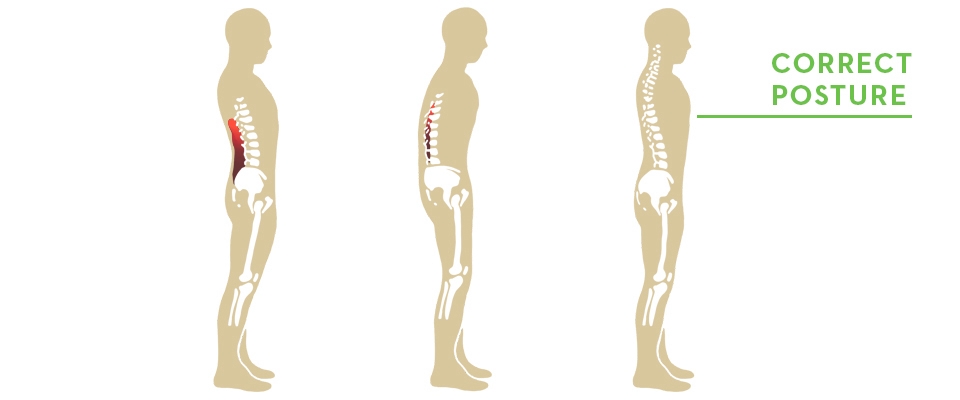
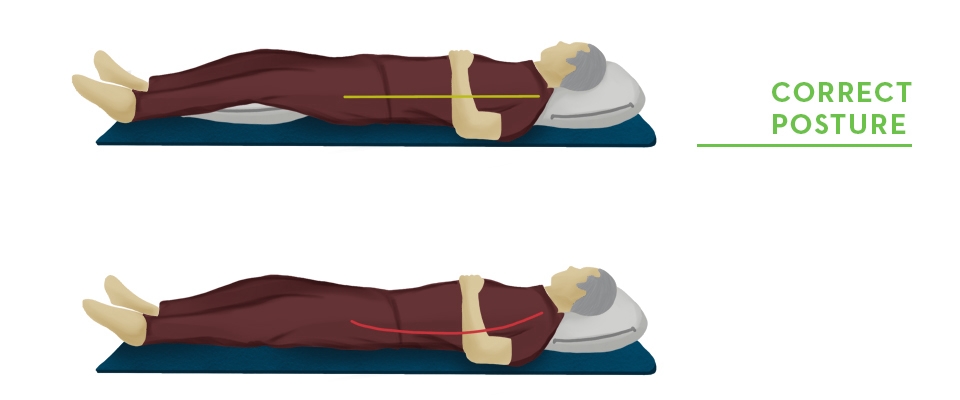
To improve your posture standing, sitting and lying down follow these instructions:
• Keep your feet on the floor or on a footrest, if they don't reach the floor.
• Don't cross your legs. Your ankles should be in front of your knees.
• Keep a small gap between the back of your knees and the front of your seat.
• Your knees should be at or below the level of your hips.
• Adjust the backrest of your chair to support your low- and mid-back or use a back support.
• Relax your shoulders and keep your forearms parallel to the ground.
• Avoid sitting in the same position for long periods of time.
• Bear your weight primarily on the balls of your feet.
• Keep your knees slightly bent.
• Keep your feet about shoulder-width apart.
• Let your arms hang naturally down the sides of the body.
• Stand straight and tall with your shoulders pulled backward.
• Tuck your stomach in.
• Keep your head level-your earlobes should be in line with your shoulders. Do not push your head forward, backward, or to the side.
• Shift your weight from your toes to your heels, or one foot to the other, if you have to stand for a long time.
• Find the mattress that is right for you. While a firm mattress is generally recommended, some people find that softer mattresses reduce their back pain. Your comfort is important.
• Sleep with a pillow. Special pillows are available to help with postural problems resulting from a poor sleeping position.
• Avoid sleeping on your stomach.
• Sleeping on your side or back is more often helpful for back pain. If you sleep on your side, place a pillow between your legs. If you sleep on your back, keep a pillow under your knees.
All the above tips will help you to have a good posture while standing, walking, sitting, and lying in positions that place the least strain on supporting muscles and ligaments. Give it a try!
a community
to help you thrive.
a lifestyle
to fit your aspirations.
a movement
to enjoy the journey
a place
to get the most out of life.
Other articles
Lorem ipsum dolor sit amet consectetur. Nisi odio purus pellentesque risus suspendisse donec.